

What Makes a PTSD Service Dog Different
A PTSD service dog is not a pet. It is not a comfort animal. It is a trained medical tool that performs specific, documented tasks to mitigate the symptoms of post-traumatic stress disorder.
For combat veterans, that distinction matters. The tasks a PTSD service dog performs are designed around the real, lived mechanics of combat-related trauma. These are not generic calming behaviors. They are precision interventions built for specific triggers that veterans face every single day.
Under the Americans with Disabilities Act, a service dog must be trained to perform work or tasks directly related to a person's disability. PTSD qualifies as a disability under that standard. The tasks described in this article all meet that legal threshold when properly trained and documented.
At TheraPetic® Healthcare Provider Group, our Licensed Clinical Doctors work with veterans regularly. The clinical picture we see is consistent: the right trained tasks can reduce avoidance behaviors, improve sleep, and allow veterans to re-engage with daily life in ways that medication alone often cannot achieve.
Perimeter Checks: Clearing the Room
One of the most common combat-related PTSD symptoms is hypervigilance. A veteran walks into a room and cannot stop scanning for threats. Sitting with their back to a door feels physically dangerous. Entering a new space without knowing what is inside it triggers the same nervous system response as actual combat.
Perimeter checks are a trained task built specifically for this symptom.
The dog is trained to walk the perimeter of a new space on command. It moves through rooms, checks behind doors, and returns to the handler with a clear, calm signal. That signal tells the veteran's nervous system that the space is safe. The dog has done the threat assessment. The handler does not have to.
This is not the dog acting instinctively. It is a deliberately trained behavior chain. The dog learns a cue word or hand signal. It learns the expected search pattern. It learns the return behavior and how to signal an all-clear. Trainers use operant conditioning with positive reinforcement to build and proof this behavior across dozens of different environments.
For veterans who feel trapped by hypervigilance, perimeter checks can be the difference between going to a restaurant with family and staying home alone.
Nightmare Interruption: Breaking the Cycle
Sleep disruption is one of the most damaging and least talked-about effects of combat PTSD. Nightmares are not just bad dreams. For many veterans, they are full re-experiencing events with elevated heart rate, physical movement, vocalizations and waking in a state of acute physiological distress.
Nightmare interruption is a trained task in which the service dog wakes the handler during a nightmare event. The dog is trained to recognize the physical cues that accompany a nightmare. Restless movement. Changes in breathing. Vocalizations. Elevated distress signals the body produces before the handler is conscious of them.
When those cues are detected, the dog intervenes. It may paw at the handler, nudge with its nose, or place its full body weight across the handler's legs depending on what has been trained. The goal is to break the sleep cycle before the nightmare reaches full intensity.
This task can be trained through a combination of shaped behaviors and scent-based conditioning. Some trainers use recordings of the handler's own distress cues during training to help the dog learn the specific signals to watch for. Proofing this task requires patience. It must work reliably in the dark, in different sleep environments and without a verbal command from the handler.
Veterans who have worked with nightmare interruption-trained dogs consistently report improvements in sleep quality and a reduction in the dread that surrounds going to bed. Our Licensed Clinical Doctors observe this regularly in the veterans they support through the TheraPetic® documentation process.
Crowd Management and Tactical Positioning
Crowded spaces are a significant trigger for combat veterans with PTSD. Grocery stores, airports, stadiums and public transit can activate the same threat-detection response that kept veterans alive downrange. The brain does not differentiate between a civilian crowd and a hostile environment when the nervous system is stuck in a threat-detection loop.
Crowd management tasks address this directly.
One of the most effective trained behaviors is tactical positioning. The dog is trained to position itself behind the handler to cover the six o'clock position. This creates a physical buffer between the handler and the people moving behind them. That buffer gives the nervous system a signal it can process: the back is covered.
Another crowd management task is crowd blocking. The dog is trained to create a physical space around the handler by sitting or standing perpendicular to the flow of foot traffic. This prevents strangers from getting too close and eliminates the unexpected physical contact that can trigger acute distress responses.
A third task is the "find exit" or "find seat" behavior. The dog is trained to guide the handler to an exit, a wall or a specific low-stimulation position in a space. This gives veterans a recovery route when a crowded environment becomes overwhelming before it reaches crisis level.
These tasks are trained through systematic desensitization in progressively more stimulating environments. The dog must be able to perform crowd management tasks reliably around strangers, noise, movement and unpredictable stimuli. That kind of proofing takes months of deliberate training.
For veterans who have stopped going to public spaces entirely, crowd management tasks can represent a genuine return to participation in civilian life. If you are exploring whether a service dog could help with public access challenges, our free eligibility screening is a good place to start.
Grounding During Flashbacks
A flashback is not a memory. It is a full-body re-experiencing event. The veteran is not thinking about what happened. Their nervous system is responding as if it is happening right now. Cognitive tools are often inaccessible during a flashback because the prefrontal cortex is offline.
That is exactly why physical grounding tasks are so effective. They work below the cognitive level.
The most widely trained grounding task is deep pressure therapy. The dog places its full body weight on the handler's lap or chest. The physical pressure activates the parasympathetic nervous system. It interrupts the acute stress response through direct sensory input. Veterans describe it as being pulled back into the present moment by something they can physically feel.
Another grounding task is tactile stimulation. The dog nudges, licks or paws at the handler repeatedly until eye contact is made or distress signals decrease. This behavior creates an external sensory anchor that the brain can use to re-orient to the present environment.
A third variation is the "check-in" or "visit" task. The dog approaches the handler on a timed or distress-cued basis throughout the day to provide brief physical contact. For veterans who dissociate frequently, these scheduled check-ins help maintain connection to the present without requiring the veteran to initiate.
Grounding tasks are trained using shaping techniques where the dog learns to associate the handler's distress signals with the grounding behavior. The behavior must be durable under high-stress conditions and must not be extinguished by the handler's distressed reaction during a flashback event. Proofing this task in real-world environments is critical to its reliability.
How These Tasks Are Trained
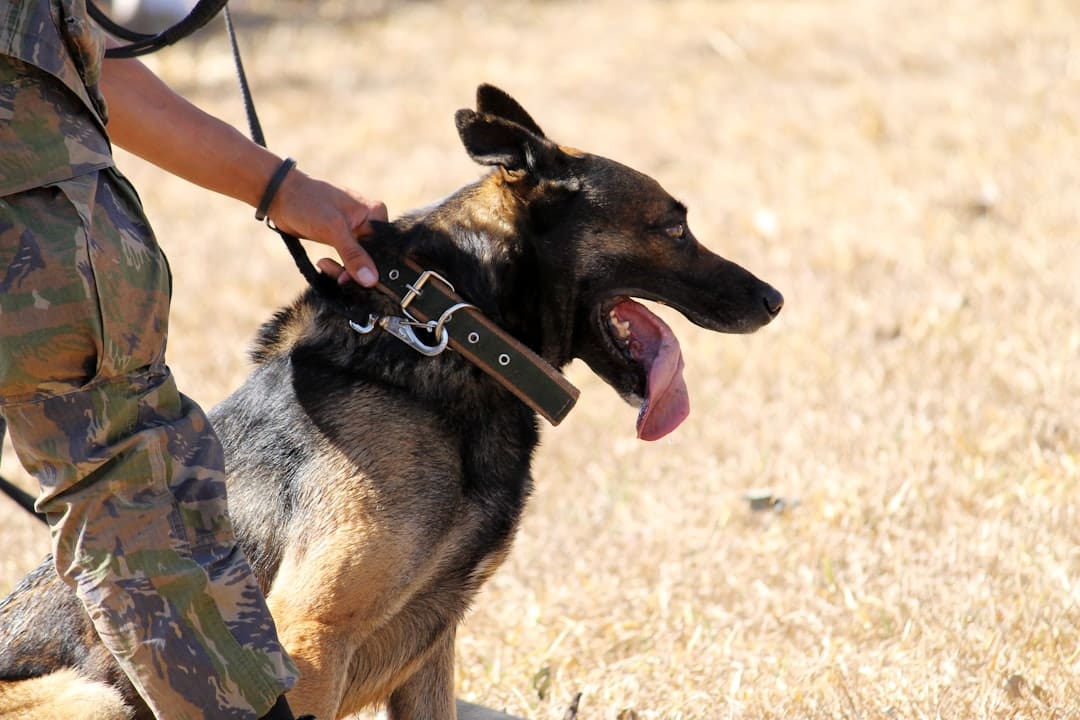
Every task described above is the result of deliberate, methodical training. None of them are natural dog behaviors. They are built through operant conditioning using positive reinforcement as the primary tool.
Training a PTSD service dog for combat-specific tasks typically falls into three phases.
The first phase is foundation work. The dog learns basic obedience, leash manners, public access behavior and impulse control to a high standard. This is non-negotiable. A service dog that cannot ignore distractions, remain calm in public spaces and respond reliably to handler cues cannot perform complex psychiatric tasks.
The second phase is task training. Each task is broken into component behaviors. Those behaviors are shaped, chained and proofed individually before being combined into the full task sequence. A perimeter check, for example, starts with teaching the dog to move away from the handler on cue, then to follow a wall, then to return and signal. Each piece is trained separately and then linked.
The third phase is public access proofing. The dog must perform all trained tasks reliably in the environments where the veteran actually needs them. That means grocery stores, parking lots, medical offices, crowded transit hubs and restaurants. A task that works in a quiet training room is not a service task until it works in the real world.
Owner-trained service dogs are legal under the Americans with Disabilities Act. Veterans can train their own service dogs with the guidance of a professional trainer. Program-trained dogs from accredited organizations are another option. The Assistance Dogs International accreditation standard is the recognized benchmark for program quality. The U.S. Department of Veterans Affairs also maintains resources on service dog programs for veterans through its healthcare system.
Learn more about how service dogs are recognized and what documentation supports access rights at Service Dog of America's rights resource page.
Legal Rights for Veteran Service Dog Handlers
Veterans with PTSD service dogs have clearly defined legal protections across multiple federal statutes.
Under the Americans with Disabilities Act, a service dog trained to perform disability-related tasks must be granted public access. A business cannot ask for documentation or certification. They may only ask two questions: is the dog a service dog required due to a disability, and what task has the dog been trained to perform.
Under the Fair Housing Act, a veteran with a service dog is entitled to keep that dog in any housing, including properties with no-pet policies. No breed restrictions or weight limits apply. No pet deposits can be charged. The housing provider may request documentation of the disability-related need.
Under the Air Carrier Access Act as revised by the U.S. Department of Transportation, psychiatric service dogs traveling by air must be accepted in the cabin as service animals. Airlines may require advance documentation and are permitted to require a DOT service animal form completed by a Licensed Clinical Doctor.
Veterans using VA-sponsored service dog programs may also have access to veterinary care coverage for their service dogs through VA benefits. The specifics of that coverage have evolved and veterans should contact their VA representative directly for current eligibility information.
Getting Started with a PTSD Service Dog
The path to a PTSD service dog starts with an honest assessment of what symptoms you are managing and which trained tasks would address them. Combat-specific PTSD does not always look the same from one veteran to the next. The tasks that matter most are the ones that meet your specific triggers.
Our Licensed Clinical Doctors at TheraPetic® Healthcare Provider Group work with veterans to assess PTSD symptoms and identify which trained tasks are clinically appropriate. That clinical assessment is the foundation of any legitimate service dog documentation.
TheraPetic® is a 501(c)(3) nonprofit healthcare provider, and our mission is to make that process accessible to veterans who have already given enough. We do not believe that accessing legitimate clinical support should be another obstacle to clear.
If you are a veteran wondering whether a PTSD service dog could help, start with our free eligibility screening. It takes a few minutes and gives you a real answer from a real clinician. You can also reach our support team directly at help@mypsd.org or by calling (800) 851-4390.
Veterans have the right to tools that work. A PTSD service dog trained to perform combat-specific tasks is one of the most evidence-supported interventions available for trauma-related disability. You do not have to navigate that alone. Explore your options at go.mypsd.org and take the first step toward reclaiming your daily life.
Written By
Ryan Gaughan, BA, CSDT #6202 — Executive Director
TheraPetic®® Healthcare Provider Group • About • LinkedIn • ryanjgaughan.com
Clinically Reviewed By
Dr. Patrick Fisher, PhD, NCC, BC-TMH, C-AAIS — Founder & Clinical Director • The Service Animal Expert™
Editorial Review
This article was reviewed by Dr. Patrick Fisher, PhD, NCC, BC-TMH, C-AAIS on May 6, 2026 for accuracy, currency, and clarity. Content is updated when laws or guidance change.